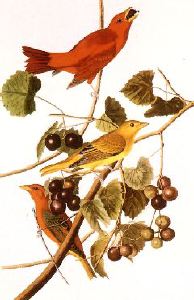
 Painting by James Audubon
(Clicking picture will take you to the National Audubon Society)

John James Audubon 1785-1851
John Audubon gave several different accounts of his birth, but the discovery of records in France in the early 1900's established that he was the son of a French Naval Captain and a French girl who worked for Captain Audubon at his sugar plantation in Santo Domingo (Haiti). Audubon's real mother died within a short time after his birth so Audubon's father took him back to France as a young child where he was adopted by Captain Audubon and his legal wife. Apparently to hide his illegitimate birth, Audubon gave different stories and led some people to believe he was born in Louisiana or was the son of Louis XVI, the King of France. A book entitled I Who Should Command All, explores the possibility that Audubon was, in fact, the Lost Dauphin who disappeared from the tower during the French Revolution.

As a teenager, Captain Audubon sent his son to manage his plantation near Philadelphia. It was here that Audubon met and married his wife, Lucy, whose support was critical in achieving his success. During his early married years he was unsuccessful in business and attained fame as an artist only after many troubled years.
Audubon succeeded only because he went to England where his work was appreciated and subscribers made possible the long publication of his 435 prints (1826 to 1838). In the 1830's Audubon also wrote his Ornithological Biography which describes the habits of the birds he drew. He interspersed these bird biographies with episodes on life in America during this turbulent period. His writings are now considered a literary treasure and should be explored by the serious Audubon collector.
After being successful with the birds, as with any great artist, Audubon turned to another subject and undertook to publish the animals of America. This proved more difficult than he had anticipated, as many of our animals were nocturnal and their habits were hard to learn. He was greatly aided by a Lutheran minister in Charleston, South Carolina, Dr. John Bachman, whose daughters were the first wives of his two sons, John W. and Victor Audubon. In fact, John drew over half of the 155 animal plates, and Victor contributed by managing the sales and drawing many of the backgrounds.
Audubon made a trip to the "western regions" in the 1840's, his last great adventure prior to his death in 1851. He chased the great Buffalo herds, but never achieved his dream of reaching the West Coast.
Few men of his age enjoyed the travels of Audubon. He spent days and weeks in the woods studying birds and animals; and his spectacular drawings, which were criticized by some, were scenes he actually witnessed. He traveled to Paris to sell his book and never accepted an offer for a single print, always insisting that the book be sold intact. This is one reason his prints are so rare today.
Click for index